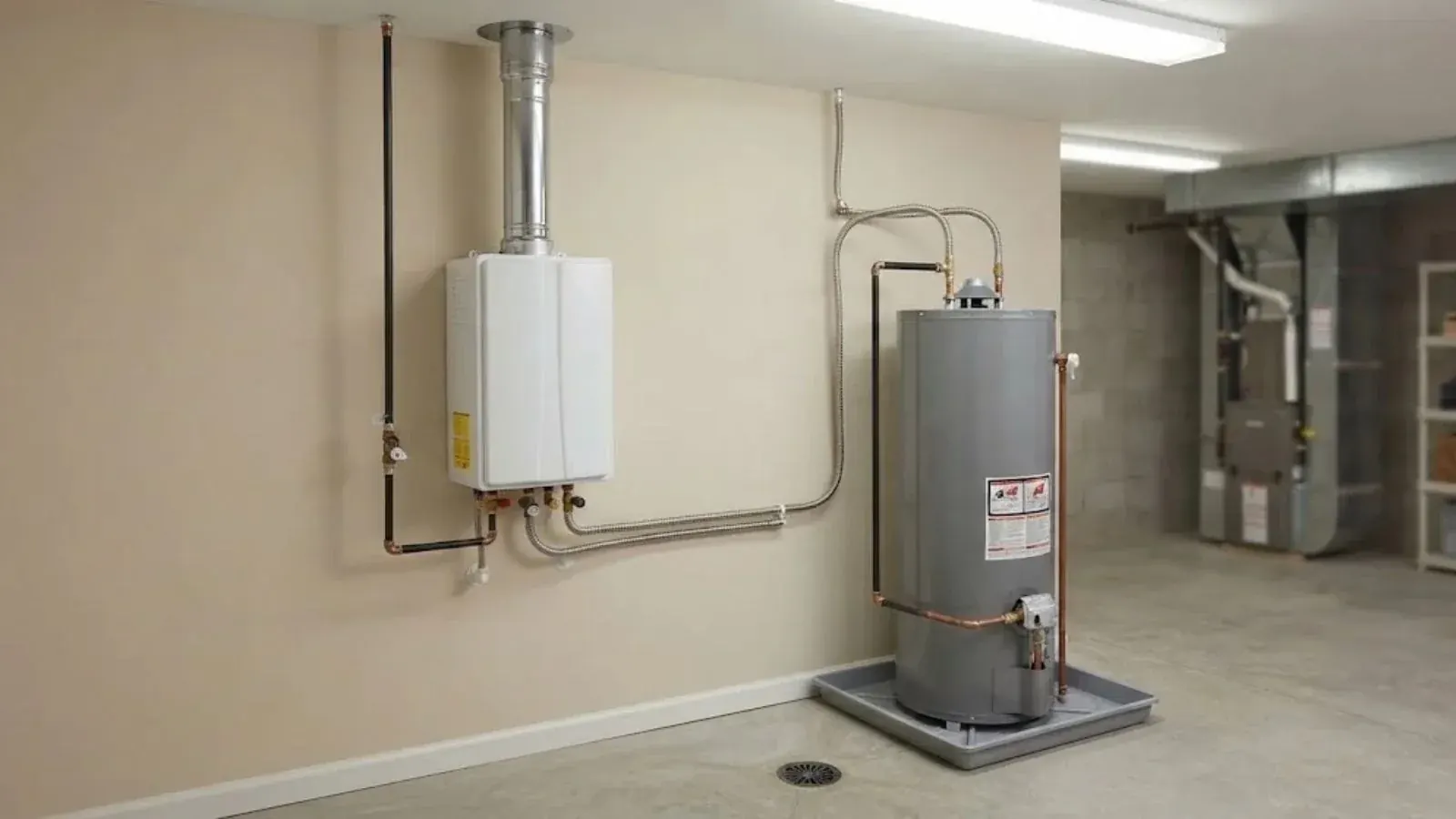
Hot water cutting out, turning lukewarm or throwing a code?
A shower that goes cold in the middle, a flow that trickles, or a display flashing a number are the common signs of a tankless problem. Most of them trace back to scale in the heat exchanger, a clogged inlet screen, a venting fault or a unit that was never sized for the load. That is what a tankless water heater service visit is built to sort out.
How an on-demand heater differs from a tank
The two types share a goal, but they behave differently day to day.
| Point | Tank heater | Tankless heater |
|---|---|---|
| Hot water supply | Limited by tank volume | Continuous, limited by flow rate |
| Standby loss | Keeps stored water hot all day | None, heats only on demand |
| Space | Needs floor space | Wall mounted, compact |
| Installation | Simple like-for-like swaps | Often new gas line, vent or circuit |
| Upkeep | Annual drain and anode rod check | Periodic flush and descale |
| Hard water impact | Sediment and rumbling | Scale chokes the heat exchanger |
| Typical lifespan | Shorter | Longer with regular upkeep |
Our water heater replacement page explains how to weigh the two options if your tank has already failed.
Installing a tankless unit
The usual surprise is the gas line. Many tankless gas models draw far more gas at full burn than a tank does, so the existing line, meter capacity and shutoff must be checked. Venting is the other big item, since most units need dedicated stainless or special plastic vent runs and a clear termination point.
Electric tankless models skip the vent but can need a very large circuit and panel capacity, which in older apartments and small homes is not always available. We verify the gas or electrical side first, then size the unit by how many fixtures run at once. A planning visit is part of our water heater installation work, and we also install isolation valves so the unit can be flushed later.
Common tankless repairs
These are the faults we see most on tankless heaters.
- Error codesCodes usually point to ignition, flame sensing, venting, flow or temperature sensors. We read the code, then test the part it names.
- Cold water sandwichA burst of cold between hot streaks often means a small flow that does not trigger the unit, or a recirculation setup issue.
- Low or fluctuating flowA clogged inlet filter, scaled exchanger or a partly closed isolation valve restricts water.
- LeaksLeaks at unions, a cracked heat exchanger or a failed relief valve need different fixes. A cracked exchanger may mean replacing the unit.
- Condensation and drain faultsHigh-efficiency models make acidic condensate and need a clear drain and a neutralizer cartridge that is checked.
If a tankless heater started to leak, shut the cold supply and power off, then call. Some leaks hide inside the cabinet.
Flush and descale: the upkeep that decides how long it lasts
The city's figures are 214 mg/L for groundwater and 235 mg/L for MWD blend water. Dividing by 17.1 gives about 12.5 and 13.7 grains per gallon, and the USGS calls anything over 180 mg/L very hard. For a tankless heater, that scale forms on the narrow heat exchanger passages, cuts flow, raises exhaust temperature and triggers codes.
Descaling circulates a food-safe acid solution through the exchanger using a small pump and two hoses connected to the isolation valves. We also clean the inlet screen and check the vent and condensate drain. How often depends on your tap and your usage, and the blend varies by season, so test your tap with a cheap hardness kit before you pick a schedule.
What affects tankless service and installation costs
Price depends on the job. We quote the work before we start.
Tell us the brand, model and symptoms, and we will explain what to expect and give a clear price.
Call (213) 672-5590A softener can protect the exchanger
Descaling treats the symptom. A softener removes most of the calcium and magnesium before the water reaches the heater, so scale builds far more slowly. For a tankless unit in very hard water, the combination of a softener and an annual flush is the most reliable setup we know of.
The trade-off is cost and salt maintenance, which we explain on our water softener and filtration page. If you are on the fence, a hardness test shows how large the problem is.
Before you call about your tankless heater
These quick checks help us bring the right parts.
- Write down the codeNote the error number or flashing pattern and the brand and model.
- Check the basicsConfirm the gas valve, power and water supply are on and the inlet valves are open.
- Clean what you can reachSome units have an inlet screen you can remove, but turn off water and power first.
- Record the symptomNote whether it happens with one tap or all, and at low or high flow.
- Check the ageLook for the manufacture date, which affects warranty and the repair decision.
If you smell gas near the unit, leave and call SoCalGas or 911 before calling us. Tankless units must follow the manufacturer's venting rules and the California Plumbing Code (UPC based), and gas sizing is checked against both before install.
Is tankless worth it for your home?
Tankless suits households that run out of hot water, want to free closet space, or have steady daily use. It can disappoint homes with a very tight gas supply, long pipe runs, or low-flow fixtures that never fire the burner. Ask for a load calculation before you buy, and ask for the maintenance plan in writing.
What a service visit includes
Here is how we approach a repair or tune-up call.
- Read the historyWe ask about codes, symptoms, how old the unit is and whether it has ever been flushed.
- Check inputsWe confirm gas pressure or electrical supply, water flow, inlet screen condition and vent integrity.
- Test componentsWe test sensors, igniter, flame rod, fan and thermistors as needed.
- Flush if neededIf scale is the cause, we descale and reassemble the isolation valves.
- Report and planYou get a clear price for any parts, and a recommendation on repair versus replacement.
Questions homeowners ask
The usual causes are low flow that does not keep the burner lit, a scaled heat exchanger, or a clogged inlet screen. In very hard water, scale is common. We test flow, clean the screen and flush the unit, then check whether the unit is correctly sized for your fixtures.
Most makers suggest at least once a year, and more often in very hard water. Huntington Park's average hardness is in the very hard range, so a yearly flush is a sensible starting point. Test your tap, since it varies by season and source.
The city reports 214 mg/L in its groundwater and 235 mg/L in MWD supply, about 12.5 and 13.7 grains per gallon. That is very hard by USGS standards and enough to scale a heat exchanger over time. A softener and regular flushing slow it considerably.
Often yes. Many gas models draw much more gas at full burn than a tank. We check your existing line, meter and shutoff against the unit's input rating before we quote, and we tell you if an upgrade is needed.
Sometimes. A leak at a union, valve or fitting is a repair. A leak from a cracked heat exchanger usually means replacement. Shut off the cold supply and power, then call so we can find the source.
It can be. Check the breaker or gas valve, the isolation valves and any displayed code. If the unit shows a code or will not fire, call us. A fault with the vent, flame sensor or igniter is a typical cause.
Yes, we also cover towns like South Gate, where the city reports hardness around 226 mg/L. Give us the brand and model when you call so we can plan parts.