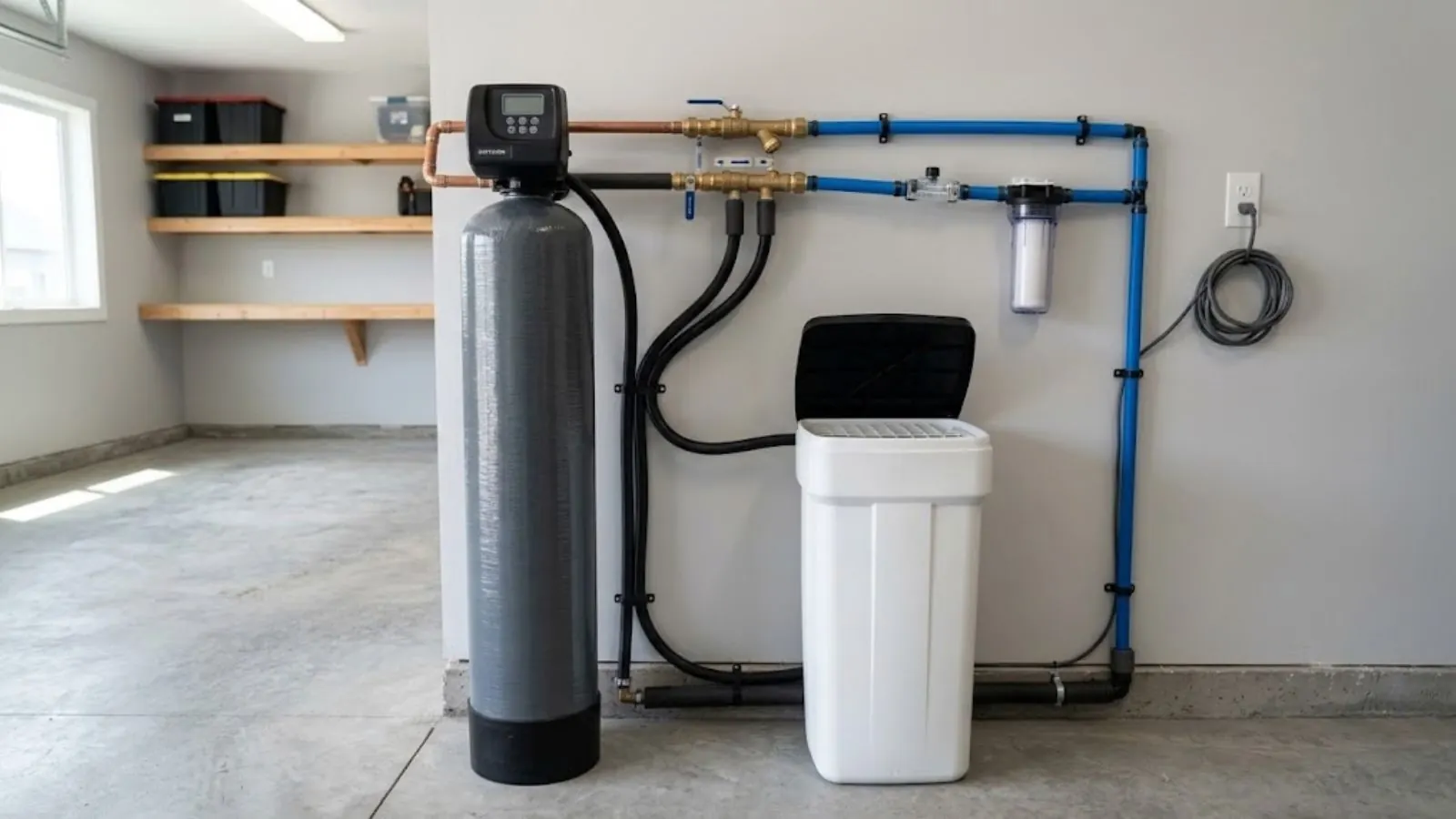
White crust, spotted glass, stiff laundry and a short-lived heater
Those are the everyday signs of very hard water: chalky buildup on faucets and showerheads, film on glass, soap that will not lather, and water heaters that rumble or fail early. They are a scale problem, not a dirt problem. A water softener, sized to your household and your actual hardness, is the usual fix, and this page explains how to choose one without overspending.
What the local numbers say
The City of Huntington Park's 2025 water quality report lists total hardness for local groundwater at an average of 214 mg/L, with a range from 185 to 233. Water bought from the Metropolitan Water District averages 235 mg/L, ranging from 189 to 280. The USGS scale calls anything above 180 mg/L very hard.
Most softener makers rate hardness in grains per gallon, and you convert by dividing mg/L by 17.1. That puts local groundwater near 12.5 grains and MWD water near 13.7. South Gate's 2021 city report gave about 226 mg/L, or 13.2 grains. Your tap can differ because the city blends sources and the mix shifts by season, so test your tap with a kit or ask for a lab test before you size anything.
Softener, filter or reverse osmosis: an honest comparison
People often buy the wrong one. This table shows what each does and does not do.
| System | What it does | What it does not do |
|---|---|---|
| Salt-based softener | Removes hardness minerals so scale stops forming | Does not remove chlorine taste, sediment or most other contaminants |
| Salt-free conditioner | Changes how scale crystals form so they stick less | Does not remove the minerals, so results vary |
| Carbon filter | Reduces chlorine taste and odor | Does not soften water |
| Sediment filter | Catches sand and particles | Does not soften or remove dissolved minerals |
| Reverse osmosis (under sink) | Filters drinking and cooking water at one tap | Too slow for whole-house flow, wastes some water |
Many homes end up with a softener for the whole house and, if they want it, a small RO unit at the kitchen sink.
How to size a softener in grains
Sizing is arithmetic, and a good plumber shows it to you.
- Count the peoplePlan on roughly 60 to 80 gallons of water per person per day for a rough load.
- Use your hardnessAt 13 grains per gallon, a family of four using 300 gallons a day needs to remove roughly 3,900 grains daily.
- Pick a capacityCommon tank capacities are 24,000, 32,000 and 48,000 grains. A bigger tank regenerates less often.
- Check the flow rateThe valve must handle your peak flow without a big pressure drop, especially with several bathrooms.
- Allow for iron or other water issuesIf a lab test shows more than hardness, the system may need a pre-filter or a different media.
Undersizing regenerates constantly, and oversizing wastes salt and space. Aim for a regeneration every few days.
Salt-based versus salt-free: what to expect
A salt-based ion exchange softener truly removes hardness, so scale on elements, glass and fixtures drops dramatically. It does need salt refills, a drain connection for regeneration backwash and a bit of attention. Many people find that a yearly check and a bag of salt a month or two is a reasonable trade for clean fixtures.
Salt-free systems are template-assisted crystallization or similar conditioners. They avoid the salt and drain, but they do not lower hardness readings, and results on appliances are less certain. If scale protection for a water heater is the main goal, salt-based is the proven choice. We will tell you if a salt-free unit fits your preference. Check local rules or HOA limits on discharge before you install.
What changes the price of a softener system
We quote the full job, equipment and labor, before we begin.
Call with your hardness test result or ask us how to take one, and we will explain the choices and a clear price.
Call (213) 672-5590Where it goes and how it is installed
Installation is a plumbing job with a drain and sometimes an electrical outlet.
- Pick the locationUsually near the main water entry, in a garage or utility area, with a floor drain or a standpipe nearby.
- Cut in and bypassWe install a bypass valve so you can isolate the unit, and keep outdoor hose bibs on hard water if you wish.
- Connect drain and brine lineThe regeneration drain needs an air gap per code, and the brine tank overflow needs a line.
- Power and programThe control valve plugs into an outlet. We enter your hardness, set capacity and regeneration time.
- Test and teachWe test hardness before and after, and show you how to add salt and use the bypass.
Before you call about hard water
A few things to check first will make the visit more useful.
- Test your tapA hardness test strip or kit gives a quick reading, and a lab test is more precise.
- Check your billConfirm who supplies your water. In Huntington Park the city utility serves about 6,600 connections, so ask its Public Works office if you are unsure.
- Note the symptomsList what you see, such as scale on fixtures, spotty dishes or a heater that is noisy.
- Find a locationLook for a garage or utility space near the main water line with a drain.
- Ask permission if you rentRenters should check with the landlord or property manager before adding a system.
Photos of the water entry and the space help us plan the job. Softener drain connections need an air gap under the California Plumbing Code (UPC based), and brine discharge rules are a question for the city.
A note on health claims
We do not make health claims about softeners, filters or RO systems. If you have questions about what is in your water, read your utility's annual Consumer Confidence Report, ask your doctor, or use a certified lab. Our role is scale, flow and equipment.
Service, repair and water conditioner problems
Common softener faults are salt bridges, a clogged injector, a stuck valve, a failed brine line and resin that has aged out. If the water suddenly feels hard again, check that there is salt, that the bypass is closed and that the control valve has power. If you still see hard water, we can test and diagnose the unit.
We also repair and replace conditioners and filters, and we can service a unit that came with the home. A softener also protects your water heater and a tankless unit, whose heat exchanger is easily clogged by scale.
Questions homeowners ask
Vinegar soaking removes existing scale, but it comes back if the water stays hard. A softener stops most new scale. Because the city reports very hard water, many homes see crust form quickly. Test your tap first and then decide whether treatment is worth it for your household.
The city's 2025 report lists groundwater at an average of 214 mg/L, about 12.5 grains per gallon, and MWD water at 235 mg/L, about 13.7 grains. Both are very hard. Your tap may fall anywhere in the reported ranges, so test your tap.
We do not make health claims. A softener targets hardness minerals and does not address other contaminants. For questions about drinking water, read your utility's water quality report, ask a doctor or use a certified lab.
It depends on household size and hardness. A common method multiplies daily water use by grains of hardness, then picks a tank that regenerates every few days. We show the math for your home and check flow rate for your plumbing.
Not for hardness removal. A salt-free unit changes how scale forms but does not lower the hardness reading, so results vary. For heater protection, salt-based is more proven. If you want to avoid salt and a drain, we explain what you give up.
Sometimes. It needs a drain, access to the main supply and landlord approval. Many apartments share a supply, which limits options. Under-sink filters or showerhead filters can be easier choices for renters.
Yes, in many cases. We check for salt, power, bypass position, injector clogs and valve faults. If the resin is old or the control valve has failed, we explain whether repair or replacement is the better value. We also serve nearby towns like South Gate.