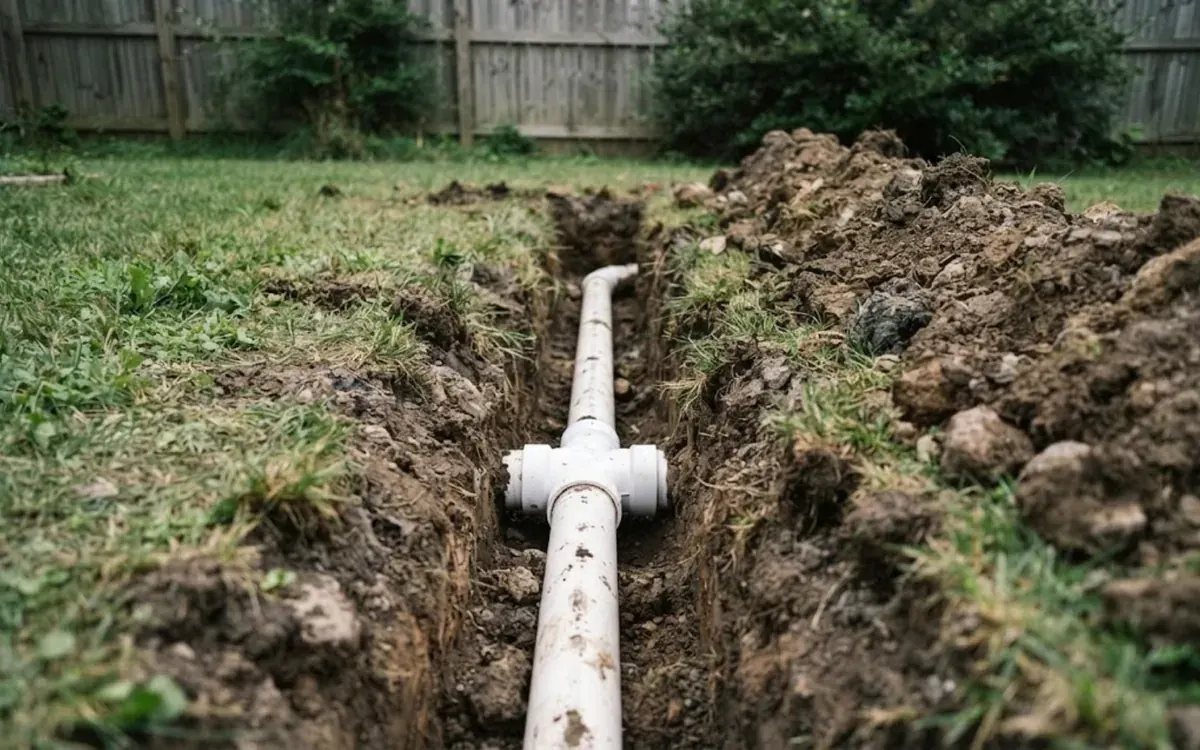
What lining actually does
The industry term is cured-in-place pipe, or CIPP. A felt or fiberglass tube is saturated with epoxy resin, pulled into the old line and inflated so it presses against the inside wall. Steam, hot water or ultraviolet light cures the resin into a rigid, smooth inner pipe.
The old pipe becomes the host and the liner becomes the new working surface. Because the liner seals cracks and open joints, roots lose their way in. Because it is smooth, flow often improves in an old rough pipe, though the inside diameter shrinks slightly.
Lining, spot repair and digging side by side
Plumbers usually choose among three approaches for a failing sewer lateral. This compares them on the points that matter to an owner.
| Point | Liner (CIPP) | Spot repair or patch | Dig and replace |
|---|---|---|---|
| Best for | Long runs of cracked, pitted or root-invaded pipe | One short damaged section | Collapsed, crushed or badly sagging pipe |
| Digging | Small access pits or cleanouts | Small pit at the damage | Open trench along the line |
| Disruption | Low to moderate | Low | Highest, yard, slab or driveway cut |
| Fixes sags and bellies | No | No | Yes, the grade can be reset |
| Fixes missing pipe or collapse | No | Sometimes | Yes |
| Pipe size after | Slightly smaller | Same | Chosen at install |
| Needs a camera first | Yes | Yes | Yes |
No row decides the question alone. The line's condition, depth, material and layout together point to one method, and sometimes a combination.
Why the camera comes first
No ethical plumber lines a pipe they have not seen. A sewer camera inspection, ideally after a hydro jet cleaning, answers these questions before anyone quotes.
- Is the pipe intact end to end?A collapse, a missing section or a break with soil showing through rules lining out for that stretch.
- How bad is the offset?Joints slightly out of line can be lined. A large step or separation usually cannot.
- Is there a belly?Standing water in a low spot means the pipe sags. A liner follows the shape, so the sag remains.
- What is the material?Clay, cast iron, Orangeburg and ABS all behave differently, and some need specific prep.
- Where are the connections?Side lines and the tie-in at the main must be reopened after lining, so their location and condition matter.
- How long is the run?Length, bends and depth set the access plan and the feasibility.
Ask for the recording and a locate of the defects. Our sewer camera inspection visit produces that evidence so you can compare opinions.
When lining fits well
Lining shines when the pipe is old but still the right shape: hairline cracks, open joints, roots entering at several spots, or pitted cast iron that sheds scale. If the line runs under a driveway, patio or slab, avoiding the trench is a major saving of mess and a smaller repair to hardscape.
It also suits cases where several defects are spread along the run. Patching them one by one adds up, and a continuous liner closes them together. Confirm the plumber's plan for cleaning the pipe first, because resin bonds poorly to grease and scale.
When it does not fit
A collapsed pipe, a crushed section or a line with a deep belly needs excavation. The liner cannot rebuild grade, and a belly that holds water will keep collecting solids and causing backups. If the camera shows missing pipe, lining would bridge nothing.
It also does not suit a line with very heavy offsets, or one where the cleanout and access are missing and cannot be added. Other times, a short break near the house is cheaper to dig and replace than to line. Our sewer line repair service weighs all of these before recommending.
The honest trade-offs
Lining shrinks the inner diameter a little, the cure needs a clean dry pipe, and workmanship varies a lot between crews. Lifespan figures come from manufacturers, so ask for the product name and its written warranty terms rather than trusting a general number. Also remember that a liner repairs the pipe, not the cause: roots will look for the next weak spot.
Questions for any lining quote
Put these on the table when you compare bids.
- Show me the pre-lining video.You should see the same defects the quote describes.
- How will you clean and prepare the pipe?Hydro jetting or cutting, then a clean surface.
- Will the connections be reopened?Side lines and the tie-in should be reinstated and re-checked by camera.
- Will I get a post-lining video?A final recording proves the liner and the openings.
- Who handles permits?Permit rules vary, so ask the City of Huntington Park building department before work starts.
- Is the plumber licensed?Verify the C-36 Plumbing Contractor classification at the CSLB site.
Huntington Park sewer notes
Huntington Park is a dense city of about 3 square miles, and its housing element describes it as nearly entirely built out. Sewer laterals often run under driveways, slabs and between close neighbors, so avoiding a trench can matter more here than on a wide lot, and a camera survey can tell you whether lining is realistic.
Who owns which part of the line is a local question. Ask the City Water and Sewer Division where its responsibility ends, because a defect in the city main is not yours to line, and a homeowner lateral is. Neighbors in Maywood and Cudahy face similar tight lots, with different water and sewer providers by address.
For the code side, the California Plumbing Code (UPC based) is the standard plumbers in the state work to, and a contractor needs a C-36 plumbing license from the CSLB to do this work.
Questions readers ask
Manufacturers publish long life expectancies, but real service life depends on prep quality, resin, installation and the host pipe. Ask for the product name and its written warranty terms, and keep the pre and post videos with your records.
Yes, after the roots are cut out and the pipe is cleaned. Lining then seals the openings roots used. Without proper cleaning, the liner can wrinkle or fail to bond, so insist on hydro jetting or cutting first.
No. A liner follows the shape of the old pipe, so a low spot stays a low spot. If the camera shows standing water, a dig and regrade of that section is usually the right repair.
Cure time is typically hours rather than days, but prep, cleaning and reinstating connections add time. Ask for a plan that says how long you cannot use fixtures, and where you can use a restroom in the meantime.
Generally the owner maintains the lateral from the house to the property line or connection point, while the city handles its main. We have not verified exact boundaries, so ask the City Water and Sewer Division about your address before you order work.