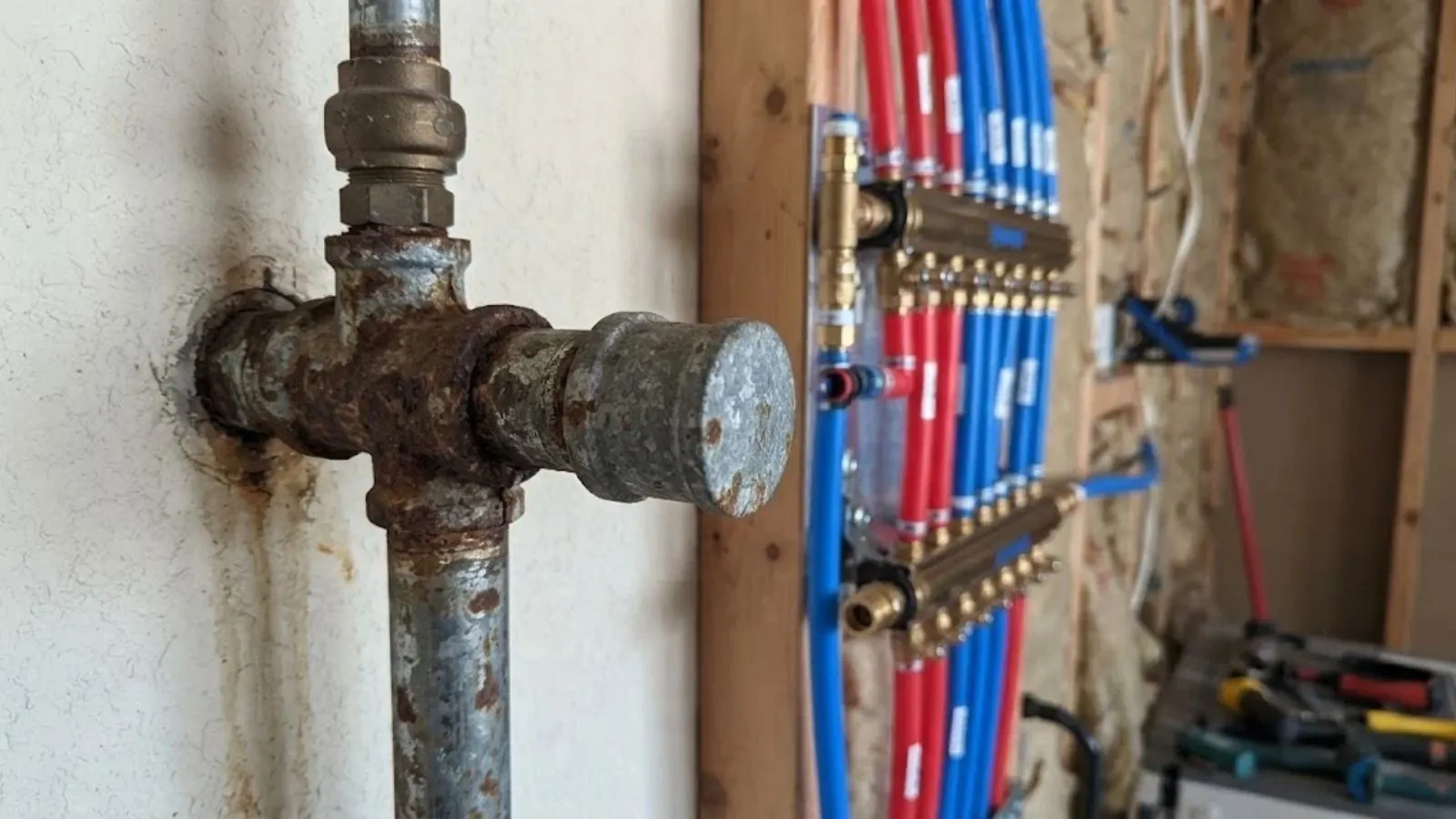
PEX in plain terms
The name stands for cross-linked polyethylene. Manufacturers take ordinary polyethylene and chemically or physically bond its long molecular chains together, which makes the tubing tougher and lets it handle hot water without going soft. The result is a bendable tube that comes in coils and in color-coded red, blue and white lengths.
Because it bends, a plumber can snake it through framing, around corners and up through wall cavities with far fewer joints than rigid pipe needs. Fewer joints means fewer places for a leak to start. That is the main reason PEX took over so much of the repiping and new-build market.
PEX against copper and CPVC
Homeowners usually meet PEX when a plumber suggests it as a replacement. This table lines up the three common water supply materials on the points that change a real decision.
| Point | PEX | Copper | CPVC |
|---|---|---|---|
| Flexibility | Bends around obstacles, few fittings | Rigid, needs many elbows | Rigid and brittle with age |
| Corrosion | Does not rust or pit | Can pit or develop pinholes over time | Does not rust, can crack |
| Joining method | Crimp, clamp or expansion fittings | Soldered or press fittings | Solvent cement |
| Sunlight | Degrades, must be covered | No effect | Can discolor and weaken |
| Heat near a heater | Needs a metal or listed connector | Handles it well | Limited tolerance |
| Typical use | Whole-house repipes, remodels | Exposed runs, heater connections | Older retrofits |
No pipe wins every row. Many good repipes mix materials, for example PEX in the walls and copper stubs at the water heater, which is a reasonable arrangement rather than a compromise.
The three grades: PEX-A, PEX-B and PEX-C
The letter tells you how the tubing was cross-linked, and it affects feel and fittings. PEX-A is the most flexible and can recover from a kink with a little heat. It is usually joined with expansion fittings, where the tube is stretched over a ring and shrinks back tight.
PEX-B is a bit stiffer and is typically joined with copper crimp rings or stainless clamps. PEX-C is less common in residential repipes. Neither grade is automatically better. What matters is that the tubing, the fittings and the tool all come from one system and are installed to the manufacturer's instructions.
Where PEX earns its place in an older home
Picture a small house or a unit in a multifamily building where the old galvanized lines are rusty inside, the water runs brown after sitting, and pressure at the shower has faded. Opening every wall to run rigid pipe is slow and messy. PEX can be pulled through small access holes, which keeps drywall repair smaller.
It also suits a remodel. If you are adding a bathroom or moving a kitchen sink, a plumber can tap into the existing supply and run PEX to the new fixtures. If the whole system is failing, a full replacement is a different job, which we cover on our repiping service page.
Where PEX should not go
The list of bad places is short but strict. Plumbers who skip these rules create the failures that give PEX a bad reputation.
- Direct sunlightUltraviolet light breaks the tubing down. Coils left outside during a job, or runs left exposed on a sunny wall, are a classic mistake.
- Straight onto a water heaterThe first stretch off a tank or tankless unit is normally copper or a listed flexible connector, not bare PEX, because of heat at the outlet and the nearby flue.
- Gas linesPEX water tubing is never a gas pipe. Gas work is its own trade with its own materials, and a plumber should treat any gas smell as a stop-work emergency.
- Contaminated soilFuel, solvents and some chemicals can permeate plastic tubing. Buried runs need approved sleeving and a clear check of local rules.
- Sharp bends and kinksBend radius limits exist for a reason. A kinked section restricts flow and can fail later, so tight turns get a proper fitting.
When you read a quote, look for how these cases are handled. A plumber who mentions the heater connection and sun protection without being asked has probably done this before.
Water quality and what PEX does and does not change
PEX does not rust, so brown water from corroded steel stops once the old pipe is gone. It does not remove minerals, though, and hard water still leaves scale in the water heater, on faucet aerators and inside valves. Pipe material and water treatment are two separate decisions, and we make no health claims about either. If taste or safety is on your mind, test your tap with a certified lab and ask your water utility for its annual report.
Questions to ask before you accept a PEX quote
Use these in the same order on every written quote and compare the answers side by side.
- Which PEX system and fittings?Ask for the manufacturer and the joining method, so you can look up its listing and instructions.
- Where does copper stay?A good answer names the heater connections and any exposed runs, and explains why.
- Who handles permits and inspection?Permit rules vary, so ask the City of Huntington Park building department before work starts, and have the plumber say who files.
- Is the plumber licensed?California plumbing contractors hold a C-36 classification, and you can check one on the CSLB license lookup before you sign.
- What about wall and ceiling repair?Find out whether patching is in the price or left to you, since access holes are part of every repipe.
How we would approach it
If you are deciding between a repair and a repipe, we start with a pressure test and a look at the pipe you already have, then explain which sections are failing. Smaller work, such as new fixture lines, fits under our plumbing installation work. Either way you get a clear price before work starts and a licensed and insured plumber on the job, with the 24/7 line available if a joint ever lets go.
Huntington Park water and plumbing notes
The City Water and Sewer Division serves about 6,600 connections with local groundwater and Metropolitan Water District supply. The 2025 report lists groundwater hardness averaging 214 mg/L and MWD water averaging 235 mg/L, both above the 180 mg/L line the USGS calls very hard. A new PEX system will not soften that, so plan on scale control at the heater.
About 73 percent of occupied homes in the city are rented, and the city's housing element describes it as dense and almost entirely built out. If you are a tenant, ask your landlord before any pipe work, and if you own a unit in a shared building, find out how your lines connect to your neighbors before a plumber opens a wall. Neighbors in South Gate and Bell get the same guidance, since supply and building age differ by address.
For the code side, the California Plumbing Code (UPC based) is the standard plumbers in the state work to, and a contractor needs a C-36 plumbing license from the CSLB to do this work.
Questions readers ask
PEX tubing sold for potable water is made to meet recognized plumbing product standards, and it is widely used in homes. We make no health claims beyond that. If you have concerns about taste or contaminants, test your tap with a certified lab and ask your utility for its annual water quality report.
Manufacturers publish long service-life figures, but real life depends on water chemistry, sunlight exposure, temperature, fitting quality and correct installation. Ask for the manufacturer's written warranty terms for the exact product, and keep that paper with your house records.
Yes, with the right transition fittings. Connecting steel to copper directly can cause galvanic corrosion, so a plumber uses dielectric or brass transitions. This is one reason partial repipes should be planned on paper before any wall is opened.
It can help when old galvanized lines were choked by rust, because clean tubing lets water through freely. It will not fix low pressure from the street, a failing regulator or a partly closed valve, so a pressure gauge reading comes first.
We have not verified a city rule, so we do not quote one. Permit rules vary, so ask the City of Huntington Park building department before work starts. A licensed plumber can tell you what they normally file and who is responsible.