Start with your hardness number
Softener sizing starts with how hard your water is. Hardness reports use milligrams per liter, and softeners are sized in grains per gallon. Divide mg/L by 17.1 to convert. The figures below come from the cities' own water quality reports.
| Source | Average hardness (mg/L) | Grains per gallon (about) | USGS class |
|---|---|---|---|
| Huntington Park groundwater, 2025 report | 214 | 12.5 | Very hard |
| Metropolitan Water District supply, same report | 235 | 13.7 | Very hard |
| South Gate groundwater, 2021 report | 226.3 | 13.2 | Very hard |
The USGS scale calls anything above 180 mg/L very hard. Huntington Park blends groundwater and MWD water, so what comes out of your tap changes by address and by season. Test your tap with a hardness kit or lab before you size anything.
What drives the install cost
Each row below changes the final number. The last column is the question to ask on the walk-through.
| Cost driver | Why it matters | Ask the plumber |
|---|---|---|
| Unit capacity | Bigger households and harder water need more grain capacity | How did you size it? |
| Single tank or dual tank | Dual tanks regenerate without interrupting soft water | Which type and why? |
| Location | Garage, side yard or closet changes pipe runs and protection | Where will it sit? |
| Drain access | Regeneration water must reach a legal drain with an air gap | Where does the brine go? |
| Electrical | Most units need a nearby outlet | Is power already there? |
| Plumbing changes | New shutoffs, a bypass valve and a hose bib loop add labor | Which fittings are included? |
| Pre-filter or add-ons | Sediment filters and carbon units are separate items | What is optional? |
| Permit or approval | Rules vary, and some buildings need sign-off | Who applies? |
Labor and plumbing changes are often a larger share than people expect. A garage install near a drain and an outlet is simpler than a unit squeezed into an apartment closet.
A worked sizing example
Say four people use about 75 gallons each per day, or 300 gallons. At 12.5 grains per gallon that is 3,750 grains of hardness per day. If you want the unit to regenerate about once a week, you need roughly 26,000 grains of capacity between regenerations.
At 13.7 grains per gallon the same household produces about 4,100 grains a day, or around 28,800 a week. This is only an illustration, and iron or other minerals change the math. A plumber should show you the calculation on the quote rather than naming a size without explanation.
Salt-based, salt-free and filtration, in plain terms
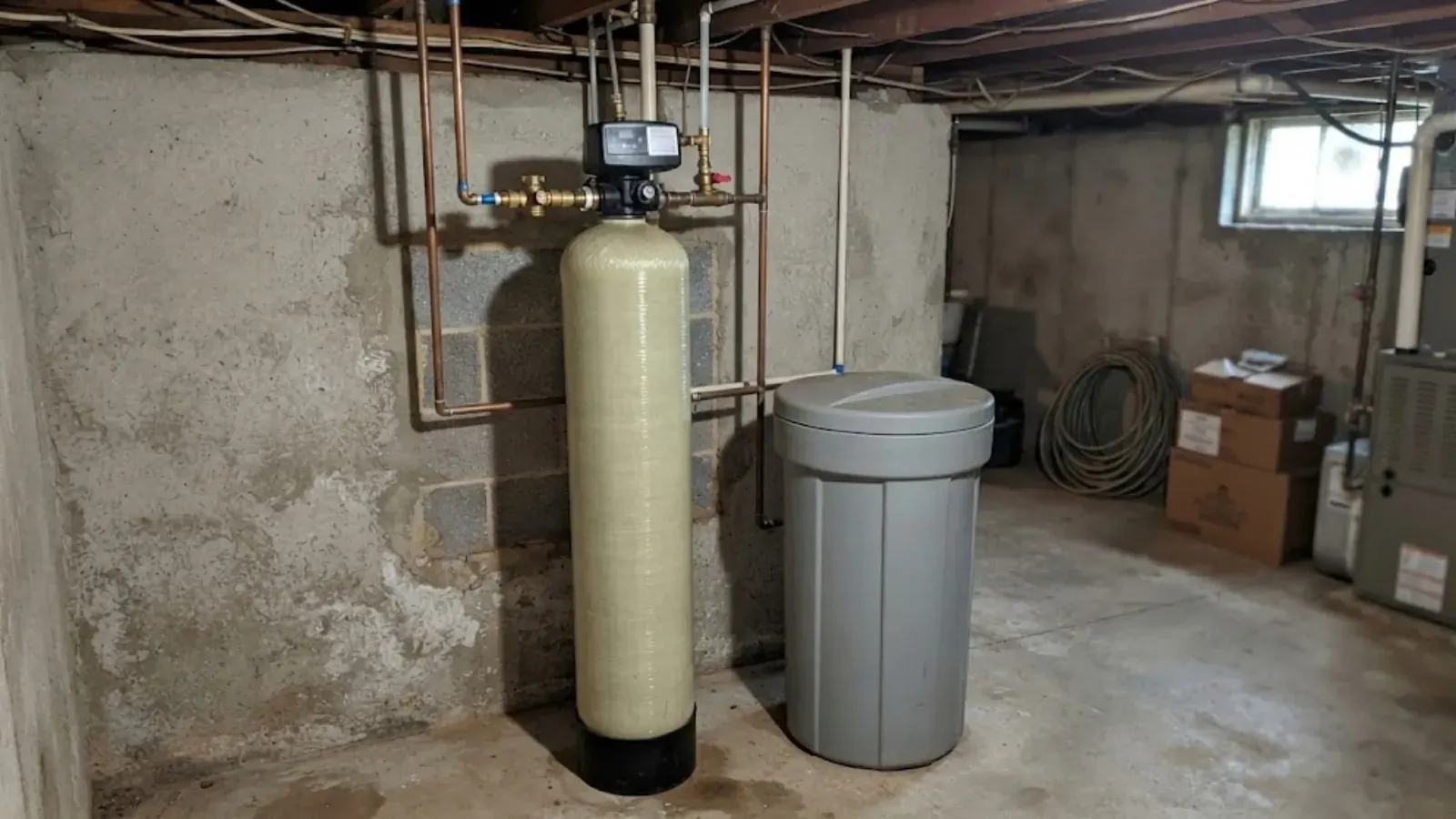
A salt-based softener removes the hardness minerals by ion exchange and flushes them to the drain during regeneration. A salt-free conditioner changes how the minerals behave and does not remove them, so results are different. A carbon or sediment filter is a separate tool for chlorine, taste or particles.
Match the tool to the problem. If scale is your trouble, a softener is the direct answer. If it is taste or odor, a filter might be, and we make no health claims for either. Our water softener and filtration page walks through these choices.
Costs after the install day
The purchase and install are not the whole story. Add these to your comparison.
- SaltSalt-based units use bags of salt or potassium chloride on a regular schedule. Ask the installer for an estimated use at your hardness.
- Water and drain useEach regeneration sends water down the drain. High-efficiency valves use less, and a plumber can tell you which type is being quoted.
- Service and partsResin eventually wears. Ask about expected resin life and what service looks like.
- ElectricityUsually small, but ask for the controller's power draw.
- Space and accessYou need clearance to add salt and to service the head, which can limit where it may go.
Where a softener helps and where it does not
A softener cuts scale that builds on heater elements, burners, faucet aerators and fixtures. It does not fix low pressure, leaks or a failing water heater, and it does not replace a flush or anode rod check. Our water heater repair visits often find scale at the bottom of the tank, which is a good reason to deal with hardness early.
Renting, condos and shared buildings
A whole-house unit connects to the main supply, so a tenant cannot add one without the owner's approval. In a condo or multifamily building, the main may serve many units, and the association decides. If you cannot treat the whole supply, a point-of-use filter at the kitchen or a descaling routine for the heater may be your realistic option.
Huntington Park hardness notes
The City of Huntington Park 2025 Consumer Confidence Report gives groundwater hardness averaging 214 mg/L, with a range of 185 to 233, and MWD supply averaging 235 mg/L, with a range of 189 to 280. That is about 12.5 and 13.7 grains per gallon. Because the range is wide, size the softener from a test at your own tap.
Next door, the City of South Gate 2021 report lists 226.3 mg/L, or about 13.2 grains per gallon, so neighbors in South Gate face similar numbers. In Bell the water company serving your address determines the report, so check which company bills you. Ask the City Water and Sewer Division and your sewer agency whether any rules cover softener discharge before you plumb to a drain.
For the code side, the California Plumbing Code (UPC based) is the standard plumbers in the state work to, and a contractor needs a C-36 plumbing license from the CSLB to do this work.
Questions readers ask
It depends on unit size, location, drain and outlet access, plumbing changes and add-ons, so we do not quote a number here. A licensed plumber should size the system from your tap test, list every line item and give a clear price before work starts.
Yes by the USGS scale. The city's 2025 report lists groundwater at 214 mg/L and MWD water at 235 mg/L, about 12.5 and 13.7 grains per gallon. Your own tap can vary, so test it with a hardness kit or lab.
Divide the mg/L figure by 17.1. For example, 214 mg/L divided by 17.1 is about 12.5 grains per gallon. Use the number from your own test if you have one, since it reflects your address.
No, softening reduces scale rather than causing it. Keep up normal heater maintenance such as flushing and anode rod checks. If the water is also very corrosive or contains iron, ask the installer about pre-treatment.
We have not verified a city rule. Permit and inspection rules vary, so ask the City of Huntington Park building department before work starts, and ask whether the drain connection needs any approval.