The short answer, then the catch
A tank heater keeps 40 to 50 gallons hot around the clock, and some heat leaks through the tank wall into the garage or closet. A tankless heater has no reservoir to keep warm, so that leak is gone. For a small household that runs hot water in short bursts, the savings are real.
The catch is that efficiency is not only about standby loss. A tankless unit that is sized for a whole house can draw a large burst of gas or electricity every time someone opens a tap, and the water it heats still has to be paid for. Homes with a lot of back-to-back showers see a smaller gap than the label implies.
Reading the rating labels honestly
Water heaters carry an energy factor or a similar rating, and tankless models usually score higher. That number comes from a standard test draw pattern, not from your family. If your real pattern is lighter or heavier than the test, your result moves with it.
Use the rating to compare models against each other, not to predict a utility bill. We do not quote percentage savings here because they change with the model, the fuel and the household. Ask the installer for the rating sheet of the exact unit and compare it to the tank you are replacing.
What the label leaves out
Ratings do not include scale buildup, a failing igniter, or a long pipe run that wastes warm water before it reaches the shower. Those factors can erase a small advantage. A flushed, well-placed unit performs closer to its label than a neglected one.
Side by side: how the two designs actually behave
Here is the practical comparison, using the questions homeowners ask us most often.
| Question | Tank heater | Tankless heater |
|---|---|---|
| Standby heat loss | Constant, through the tank wall | Almost none, no stored water |
| Hot water for back-to-back showers | Runs low, then needs recovery time | Steady until the unit hits its flow limit |
| Two showers plus a dishwasher at once | Fine until the tank empties | May fall short if undersized |
| Typical service life | Shorter, often limited by tank corrosion | Longer, if flushed on schedule |
| Maintenance | Anode rod check, periodic flush | Descale flush on a regular schedule |
| Upfront work | Simple swap in most cases | Gas line, venting or electrical upgrade may be needed |
No row wins every time. The tank is simpler and cheaper to swap, and the tankless is better at avoiding waste if the installation fits the house.
Gas versus electric: where the efficiency differs
Gas tankless heaters can deliver large flow rates, but they need a proper vent, enough gas line capacity and combustion air. Electric tankless heaters have no flue, yet they pull a very large electrical load. Many older panels cannot supply that without an upgrade, and the upgrade changes the whole cost picture.
In a dense, older neighborhood, the wiring and gas piping already in the walls often decide the fuel choice before efficiency does. Have a licensed plumber check the gas line size, and have an electrician look at the panel if you lean electric. If you smell gas at any point, leave the house and call SoCalGas (800.427.2200) or 911 before you call us.
Recovery versus standby: the trade you are really making
A tank has a recovery rate, which is how fast it reheats after you drain it. A tankless unit has a flow rate, which is how much hot water it can make per minute at a given temperature rise. They are different limits, and each one fails in its own way.
When a tank runs out, you wait. When a tankless unit is undersized, the water gets lukewarm while several fixtures run. Count your peak moment, such as two showers and a washing machine, and size to that moment instead of the average day.
Long pipe runs
If the heater sits far from the bathroom, you pour cooled water down the drain while waiting for hot. A tankless unit does not fix that, and a recirculation loop adds its own energy use. Placement matters as much as the unit type.
Hard water and the tankless heat exchanger
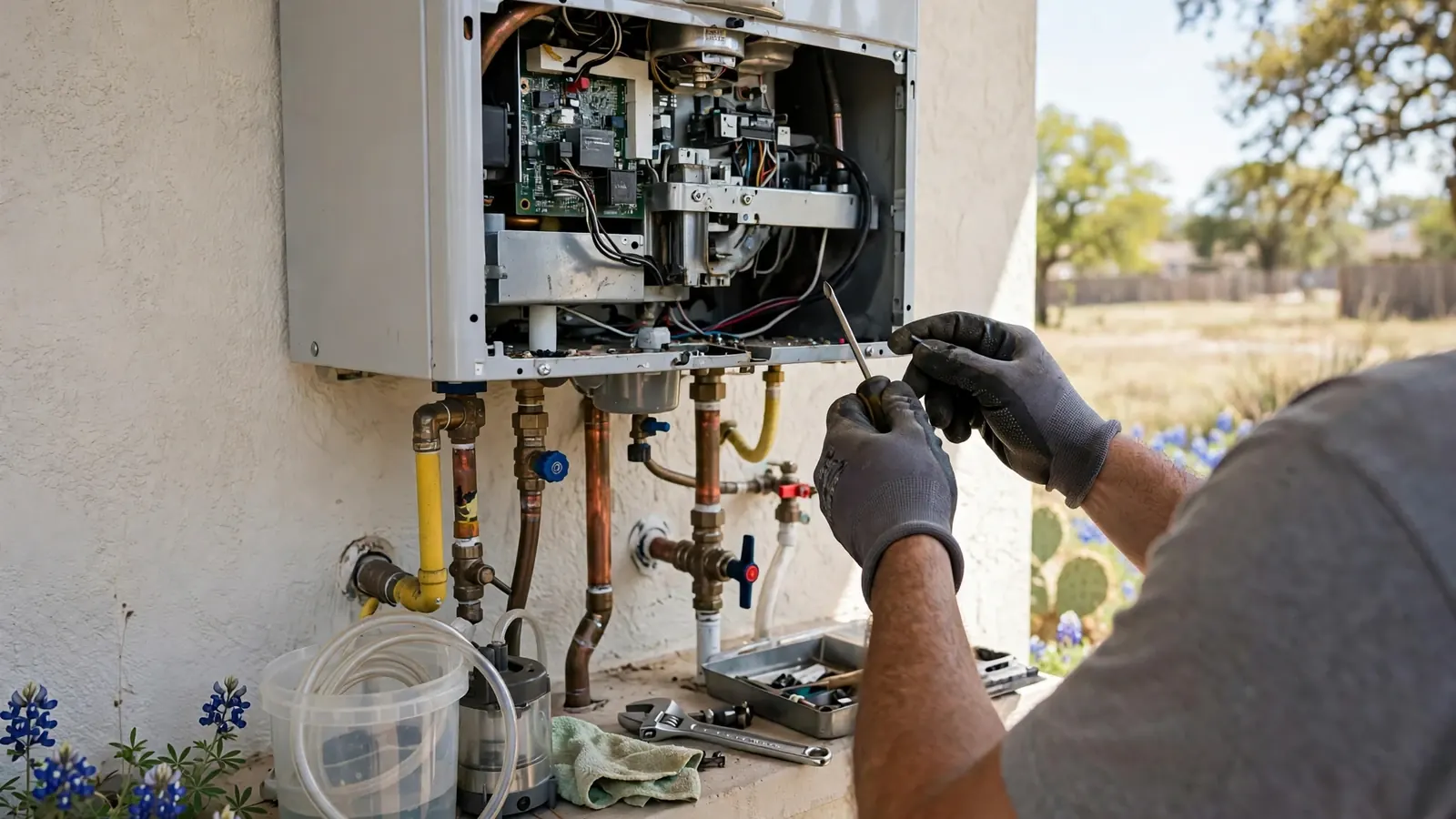
Scale is the quiet efficiency killer. A coating of mineral deposit inside a heat exchanger insulates the water from the heat source, so the unit works harder for the same output. Tankless exchangers have narrow passages, so scale shows up as error codes, temperature swings and rising noise.
Tank heaters suffer too, since sediment collects on the bottom and coats the element or burner area. The difference is that a tank can tolerate more neglect before it complains. Either way, a flush and a water test belong in your plan from the first day.
Huntington Park water and plumbing notes
See the local section below for the measured hardness of the city supply and what it means for either heater.
A decision checklist before you buy
Run through these before you compare quotes.
- Count peak demandWrite down the most fixtures that run at once in your home. Size the unit to that number.
- Check the fuel pathAsk whether the existing gas line and vent can handle the unit, or whether the panel can feed an electric model.
- Plan the flushPick a descale schedule and keep the service record. A tankless heater without it loses its advantage.
- Look at the whole billCompare installation work, not just the unit price. Venting, gas piping and wiring change the total.
- Think about the householdOne or two people with short showers suit tankless well. A large family with overlapping use may prefer a bigger tank.
Huntington Park water hardness and your water heater
The City of Huntington Park Water and Sewer Division reports total hardness in its 2025 Consumer Confidence Report. Groundwater averages 214 mg/L, which is about 12.5 grains per gallon, and the Metropolitan Water District supply averages 235 mg/L, about 13.7 grains per gallon. The USGS scale calls anything above 180 mg/L very hard.
For you, that means scale is a planning item for any heater here, and a tankless exchanger is the part most sensitive to it. Because the city blends groundwater with imported water, hardness can differ by tap and season. Test your own tap, and ask about a softener if the reading is high.
For the code side, the California Plumbing Code (UPC based) is the standard plumbers in the state work to, and a contractor needs a C-36 plumbing license from the CSLB to do this work.
Questions readers ask
Not always. It avoids standby loss, which helps most in lighter-use homes. A busy household with long, overlapping showers may see a smaller gap, and an unflushed unit loses ground to scale. Compare the rating sheet of the specific model, not the category.
Electric converts nearly all its input to heat, but it needs a large electrical load and the panel may need work. Gas has a flue loss, yet it delivers high flow. The better choice depends on your existing gas line, panel and venting. We inspect both before recommending.
The maker's manual sets the interval, and very hard water usually calls for the shorter end. We flush with a descaling solution and a small pump. Ask us for a schedule tied to your tap test.
It cannot run out in the tank sense, but it can fall short on flow. If too many fixtures open at once, the water cools. Proper sizing to your peak demand prevents most of that.
The city reports total hardness well above the USGS very hard line, so expect sediment and scale. Flushing the tank and checking the anode rod helps. If your heater is old and leaking, replacement is usually the answer.