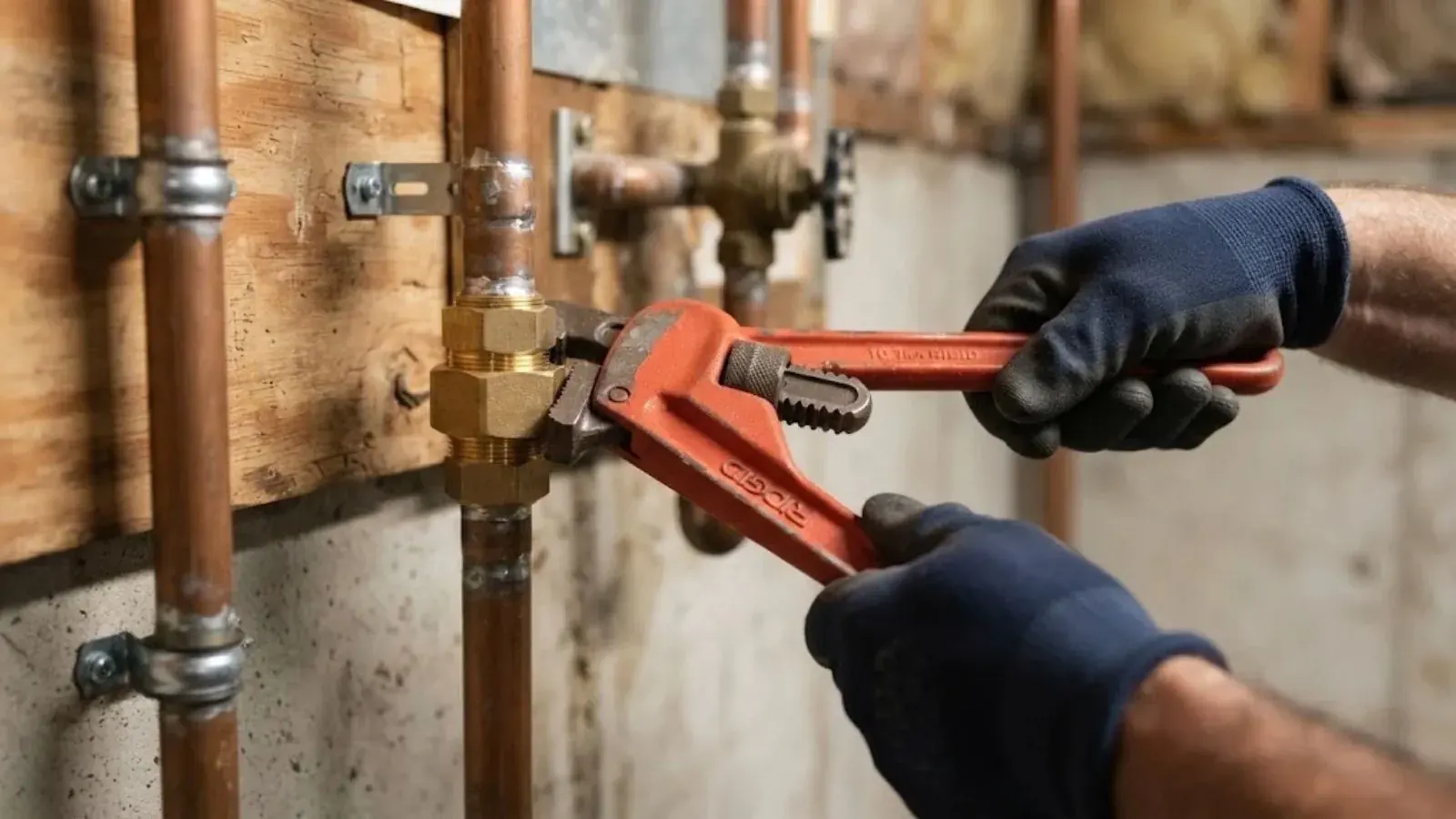
Why the order matters: gas company or 911, then a plumber
Natural gas ignites from a spark, and a spark can come from a light switch, a doorbell, a garage opener or a phone ringing inside a gassy room. That is why the order is fixed: get out, call from a safe place, wait outside. A plumber is the right call for the repair and the inspection that follow, never for the first minutes. We do not promise a gas response time, and neither should anyone else.
What you may do and what you must leave alone
The line between a safe homeowner action and a dangerous one is clear. Use this table when you are unsure.
| Situation | You may | You must not |
|---|---|---|
| Strong rotten-egg smell indoors | Leave at once, open the door on your way out, warn others, call from outside | Switch lights, use a lighter, start a car in an attached garage, search for the source |
| Faint odor near one appliance | Move away, call SoCalGas and describe where you smelled it | Tighten fittings, wrap tape on a joint, relight a pilot to test it |
| Hissing or a damaged line outdoors | Keep people away, call SoCalGas or 911 | Dig, patch or cover the area |
| Gas company says the area is clear | Ask a licensed plumber to inspect and repair | Turn the supply back on yourself if a fitting was disturbed |
| Routine concern, no odor | Book a planned inspection and pressure test | Hunt for leaks with open flame |
Never use a match or lighter as a leak detector. That mistake is still one of the most common, and it is the one that hurts people.
Signs of a gas leak worth acting on
Utilities add an odorant to natural gas so you can notice a leak. Treat any of these as a reason to leave first.
- A rotten-egg or sulfur smellThe strongest sign. A smell that comes and goes still counts, since a leak can rise and fall as appliances cycle.
- A hissing or whistling sound near a pipe or meterThat noise is gas escaping under pressure. Stay away from the area and call from a safe distance.
- Bubbles in standing water or wet soil outdoorsGas bubbling through a puddle near a meter or a buried line is a serious indicator.
- Dead patches in a lawn or garden along a lineA strip of dying plants above a buried pipe can point to leaking gas. Report it to SoCalGas.
- Pilot flame or burner color that looks wrongA flame that is mostly yellow or orange instead of blue suggests a combustion problem. Turn the appliance off and have it checked.
- Headache, nausea or dizziness that clears outdoorsWe make no health claims, since many things cause these symptoms. If you feel unwell and suspect gas, go outside and call 911.
Any one is enough. You do not need to be certain before you call.
What a licensed plumber does in a planned inspection
A planned gas line inspection is a scheduled visit made when there is no emergency. It makes sense when a leak is suspected but the utility has cleared the home, when you are adding an appliance, or when you are buying a property. Our plumbing installation team handles gas piping work, and a licensed plumber holds a California C-36 plumbing contractor license that you can check on the CSLB site.
Visual check of piping and appliance connections
The plumber looks at every visible run: black iron, flexible connectors, shutoff valves and the points where pipe meets an appliance. Rust, kinked connectors and missing shutoffs are all marked.
Pressure test
For a pressure test the plumber isolates the piping, connects a calibrated gauge or manometer and holds a set test pressure for a set time. A needle that drops means a leak somewhere in the section under test. The test shows whether leaking exists, and the next steps show where.
Pinpointing the leak
Once a leak is confirmed, the plumber uses an electronic combustible gas detector to sniff along joints and a leak-test solution that bubbles at a pinhole. Hidden pipe may need access through a wall or a trench.
Written findings and repair options
You should receive a clear list: what leaks, what is worn, and what can wait. Repairs range from replacing a flex connector to re-running a section of pipe. Ask what the California Plumbing Code (UPC based) requires and whether the City of Huntington Park building department needs to be involved, since permit rules vary.
Good reasons to schedule a gas inspection
Schedule one before you buy a house or a duplex, since a seller's disclosure will not describe the piping inside the walls. Schedule one after a remodel that moved a range, a dryer or a water heater, and after any event that shook or struck the piping, such as an earthquake or a vehicle hitting a meter.
Book one before a new tenant moves in if you are a landlord, and after SoCalGas has cleared a smell that nobody could explain. A planned test also gives you a baseline, so a later change in the readings means something.
After SoCalGas clears the area
Once the utility says the area is safe, ask them which parts of the system they handle and which belong to you. As a general rule the utility is responsible up to its meter and the customer is responsible downstream, but ask SoCalGas to confirm for your property.
If the house piping is the problem, a plumber will repair or replace the faulty section, then pressure test again before the gas is turned back on. Do not turn a shutoff back on yourself if a fitting was disturbed. If you also see a damp spot or a jump in your bill, a leak detection visit covers the water side.
Myths that cause trouble
One myth is that a small smell can be ignored, but a small leak in a closed space can build. Another is that soap-and-water testing is a replacement for a professional pressure test. Soap can show a bubbling joint, but it does not tell you whether the rest of the piping holds pressure.
Gas safety in dense Huntington Park housing
Huntington Park has about 15,494 housing units in roughly three square miles, and about 73 percent of occupied homes are rented. The city's own housing element describes it as one of the densest and nearly entirely built out. For you that means shared walls and shared meters are common, so a gas smell in one unit can affect neighbors.
If you rent, leave, warn neighbors, and call SoCalGas yourself. Any resident can make that call, and you do not need to wait for the landlord. Tell the landlord in writing afterward so a licensed plumber can inspect before gas service returns.
Questions readers ask
Leave immediately, leaving the door open. Do not touch switches or light a flame. From a safe place call SoCalGas at 1 800 427 2200, and call 911 if there is danger or you cannot reach them. Call a plumber only after the gas utility has cleared the home.
A visual check and an electronic detector can work with the gas on, but a pressure test needs the section isolated and the gas off. The plumber handles the shutoff and restores service only after the test passes. Do not turn it back on yourself.
Your nose catches a leak that is releasing odorant right now. A pressure test checks whether closed piping holds a set pressure for a set time, so it can find a slow leak that has little smell. It is the standard way to prove piping is tight.
Not always. Many leaks are at fittings, valves or appliance connectors you can reach. Buried piping may need excavation, and that happens only after the plumber has located the leak. Ask for the plan in writing before work starts.
The house piping and the appliances the landlord supplies are normally the owner's job to keep safe. Tenants should still call SoCalGas about any smell, then tell the landlord in writing. For lease questions, check your rental agreement or ask a tenant resource group.