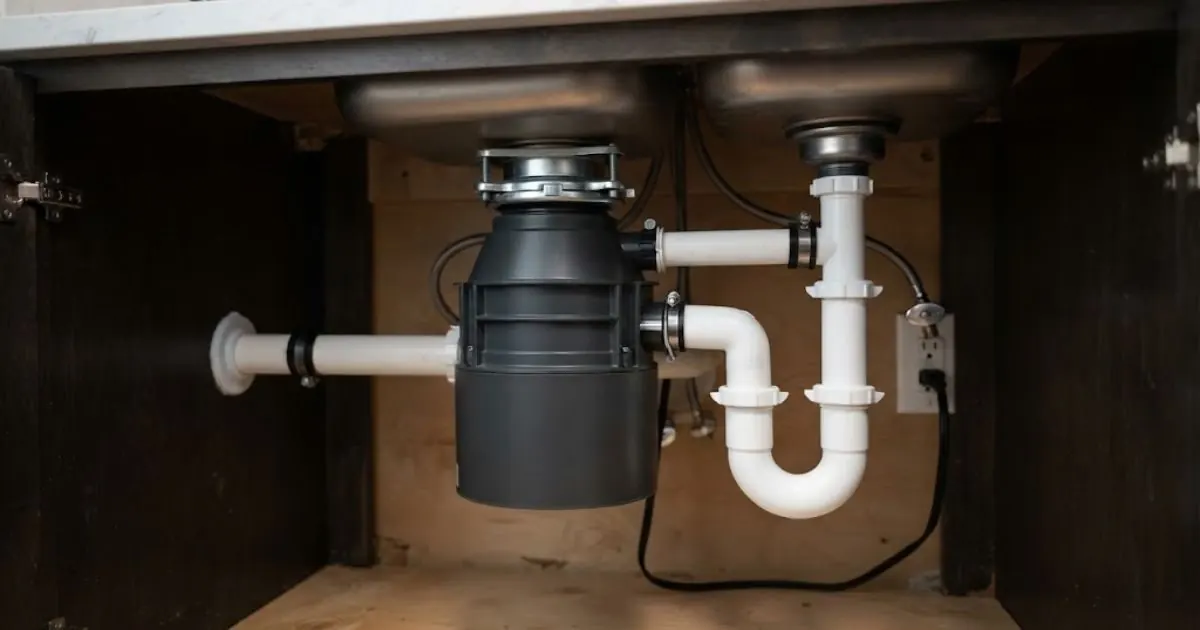
When a disposal leak under the sink is an emergency
Water pooling in the cabinet is the call we hear most at night, because the sink keeps getting used and the leak keeps growing. A steady drip from the bottom of the unit, a spray at the dishwasher hose or a flooded cabinet floor should be handled the same day. A jam that only hums is a smaller problem, and a clean switch-off and a call usually keeps it from becoming a bigger one.
Electrical safety before you touch anything
Turn the disposal off at the wall switch and, if the cabinet is wet or you can reach the panel, off at the breaker. Never put a hand or fingers into the disposal, even when it is off. If something is stuck, use tongs or pliers, or the hex key socket at the bottom to turn the plate by hand. Wet wiring and standing water are a shock risk, so stay out of the cabinet if the floor is soaked.
What to do while you wait
A few quick steps reduce damage and help us diagnose faster.
- Power offSwitch the disposal off at the wall and, if safe, at the breaker.
- Stop the waterClose the sink's hot and cold stops, or the main if they will not turn.
- Catch the leakPut a pan or bucket under it and clear the cabinet.
- Do not reach inUse tongs for stuck items, never your hand, and never run the unit to test a leak.
- Skip the chemicalsDrain cleaner poured into a jammed disposal splashes back and damages the unit.
Take a picture of the leak and the label on the unit. The model number speeds up any part or replacement decision. Disposal drain connections and air gaps follow the California Plumbing Code (UPC based), and the electrical side stays on a switched, properly protected circuit.
Reading the symptom: leak, hum, jam or silence
Most disposal problems announce themselves. This table matches the sound or sign to the usual cause.
| Symptom | Usual cause | What you can do | What a plumber does |
|---|---|---|---|
| Humming, no spinning | Jammed grinding plate | Switch off, turn the hex key at the bottom, press the reset button | Frees the jam, tests the motor, replaces the unit if it keeps seizing |
| No sound at all | Tripped reset or dead power | Press the red reset, check the breaker and switch | Tests the outlet and wiring, replaces the unit if the motor is dead |
| Water at the top rim | Failed sink flange seal or plumber's putty | Stop running water into the sink | Removes the unit, reseats the flange, reinstalls |
| Water from the side | Loose drain elbow or dishwasher hose | Check the clamp for slack | Replaces the gasket, clamp or hose |
| Water from the bottom or housing | Cracked housing or seal wear | Stop using it | Replaces the unit, repair rarely holds |
| Odor, slow drain | Food buildup or a downstream clog | Run cold water with citrus peels and ice | Cleans the unit, clears the line with a cable |
Where the leak comes from decides the fix
Find the leak by drying everything and running water while watching with a flashlight and dry paper towel. The location tells you whether the repair is a ten-minute tightening or a new unit.
Leaks at the top flange
If water appears around the sink opening, the flange seal has let go. The disposal has to come down, the old putty cleaned off and the mounting ring reseated. This is a repair, as long as the unit itself is in good shape.
Leaks at the side connections
The discharge elbow bolts to the side of the disposal and a rubber gasket seals it. Loose bolts, a flattened gasket or a cracked pipe all leak here. This is usually a cheap repair, and we replace the trap parts if they are worn.
Leaks from the bottom or housing
Water coming from the underside or the body means the internal seal has failed or the shell has cracked. That unit is finished, and the fix is a replacement. Keep the cabinet dry and stop running the disposal.
The dishwasher connection
A dishwasher drain hose connects to a nipple on the side of the disposal. New disposals have a knockout plug inside that must be punched out, or the dishwasher will not drain and will back up into the sink. A leak or an odor from the dishwasher often traces to a loose hose clamp or a hose without a high loop under the counter.
If standing water appears in the dishwasher after a cycle, the cause may be the knockout plug, a clog in the disposal or a blockage farther down. A kitchen line that stays slow after a clean disposal needs drain cleaning with a cable machine.
What decides the price of disposal work
A reseat, a hose clamp and a new unit are very different jobs. These are the factors.
Want your real number? Call the 24/7 line, describe the leak or the sound, and we will give you a clear price before work starts.
Call (213) 672-5590Repair or replace the disposal
A good rule is to repair what is sound and replace what is leaking or old.
- Leak from the bottomReplace. The seal and housing are not serviceable.
- Repeated jamsA unit that jams every few weeks usually has worn plates, a weak motor or oversized food scraps. Replace if the motor is weak.
- AgeMany units last 8 to 12 years. After that, a repair costs about as much as a new one.
- NoiseGrinding or rattling that did not exist before points to loose parts or worn bearings.
- Smell that will not goA deep clean helps, but a unit with a cracked splash guard or old food packed in the chamber may be worn out.
What a replacement or new installation looks like
A new disposal usually takes one visit. The steps are the same whether it replaces an old one or goes in under a sink that never had one.
- Power offThe unit is switched off and unplugged, or the breaker is off if it is hard-wired.
- Remove the old unitWe disconnect the drain and dishwasher hose, loosen the mounting ring and lower the old disposal.
- Reseat the flangeA clean sink flange with fresh plumber's putty and a new mounting assembly go in.
- Mount and connectThe new unit is hung, the discharge elbow sealed, the dishwasher hose connected and the knockout plug removed.
- TestWe run water, check every joint dry, then power the unit and run it for a short test.
A new installation where no disposal existed may also need a switched outlet and a dishwasher connection. We tell you what the sink needs before work starts, and wiring beyond a simple outlet is a licensed electrician's job. See also plumbing installation for other new fixtures.
Horsepower, feed type and mounting
A one-third horsepower unit handles a light-use apartment kitchen, and a three-quarter or one horsepower model grinds tougher scraps and runs quieter. Continuous-feed units run while the switch is on, and batch-feed units run only when the lid is turned in place, which is safer around children. Look for stainless grinding parts and a three-bolt mounting ring that fits most sinks.
A single-bowl sink with a drain on one side usually accepts any standard unit. Double sinks may need a trap rearranged. Tell us the sink and the existing drain layout before we order the unit.
What a disposal should not take
Grease, coffee grounds in volume, pasta, rice, potato peels and fibrous vegetables such as celery or corn husks create the soft clogs that jam disposals and back up kitchen drains. Bones and fruit pits can dull or stop the blades. Run cold water for about 15 seconds before and after use, and put grease in a can, not the sink.
Questions homeowners ask
Yes. Our 24/7 line covers disposal leaks, floods under the sink and dishwasher backups on nights, weekends and holidays. We offer same-day appointments when available and give a clear price before work starts. Switch off power at the wall and close the sink stops while you wait.
The grinding plate is stuck, usually from a hard item or a food jam. Turn it off, then use the hex key socket under the unit to rotate the plate back and forth, and press the reset button. Never use your hand. If it hums again, the motor may be failing.
A leak at the bottom usually means a cracked housing or a failed internal seal. That is not repairable, so the unit needs replacing. Stop using it and keep the cabinet dry until we arrive. Leaks at the top or side are often cheaper to fix.
Yes. We remove the knockout plug inside the new disposal, connect the drain hose with a clamp and set a high loop or air gap as needed. Skipping the knockout plug is the most common reason a dishwasher will not drain after a disposal swap.
No. Switch it off at the wall and breaker and use tongs or a hex key instead. A hand in the chamber can be cut by plates and edges, and an accidental switch-on is a serious injury. Treat every disposal as live until the power is off at the source.
That depends on the lease and California law, which we cannot interpret for you. Report the leak in writing, stop using the unit and photograph the damage. We can explain the cause for you and the manager, and we also serve nearby towns such as Maywood.